Material guide · Skins, cores, finishes & joints
What ACM wall panels are and how they go together
A practical technical overview of aluminum composite material for general contractors, architects, and building owners: how sheets are built, how cores differ, how panels fold, and how joints shed weather.
Updated November 2026
AI-generated illustration
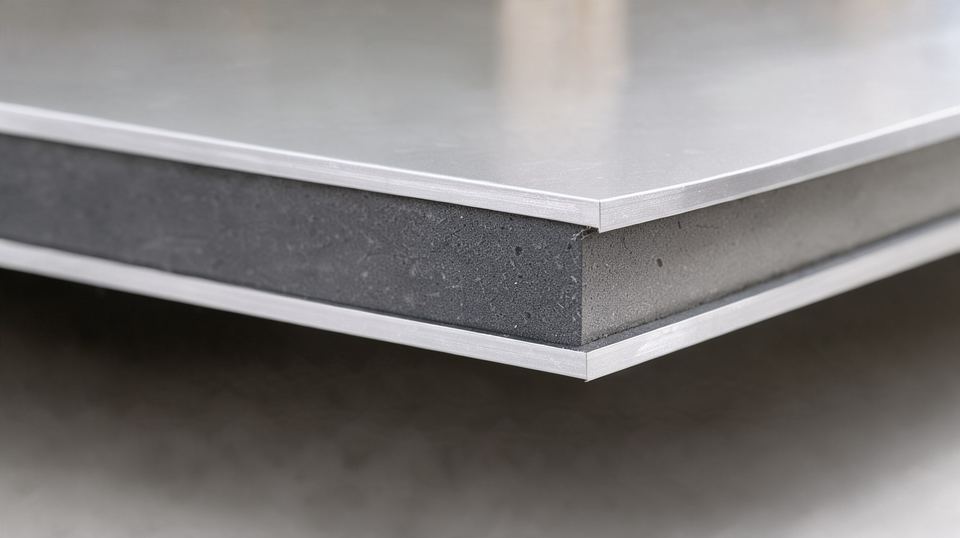
Two thin aluminum skins bonded to a structural core
ACM stands for aluminum composite material, also called MCM (metal composite material) in US specifications and ACP outside the country. Each sheet bonds two thin aluminum skins, about 0.020 inch (0.5 mm) thick, to a solid core.
Separating two tensioned skins across a rigid core works like a structural I-beam. Sheets come in wide formats, commonly up to about 60 inches wide and long custom lengths, staying lightweight, crisp at folded corners, and flat across commercial facade modules without the wavy oil-canning common in thin single-sheet metal.
PE, mineral-filled FR and noncombustible A2-type cores
Two composite panels can look identical on the face while carrying different cores inside:
- Polyethylene (PE) core: standard thermoplastic core, generally restricted by code to low-rise uses, detached canopies, and exterior sign bands.
- Fire-retardant (FR) mineral-filled core: used on buildings where codes and contract drawings require an NFPA 285 tested exterior wall assembly. An FR sheet is only one part of compliance; the air barrier, insulation, sub-framing, and joints must follow the manufacturer's tested assembly specified by the design team.
- Noncombustible / A2-type cores: higher-mineral cores specified where projects call for stricter limited-combustibility ratings.
The project architect and engineer select the core and tested assembly; we fabricate and install strictly to the approved drawings.
Panel thicknesses and factory PVDF coil finishes
Most commercial facade ACM panels are 4 mm thick overall; 3 mm sheets suit flat signage and light trims, while 6 mm panels handle special wide-span conditions.
Exterior skins receive factory coil-applied PVDF fluoropolymer coatings for long-term fade and chalk resistance, or FEVE coatings for vivid colors and higher gloss. Standard solid colors sit alongside mica and metallic shades, brushed and anodized-look finishes, and printed wood-grain or stone-look patterns. Directional finishes carry arrows on the peel-off protective film so panels are routed and hung in one consistent coil direction before the film is stripped at completion.
How CNC route-and-return panel fabrication works
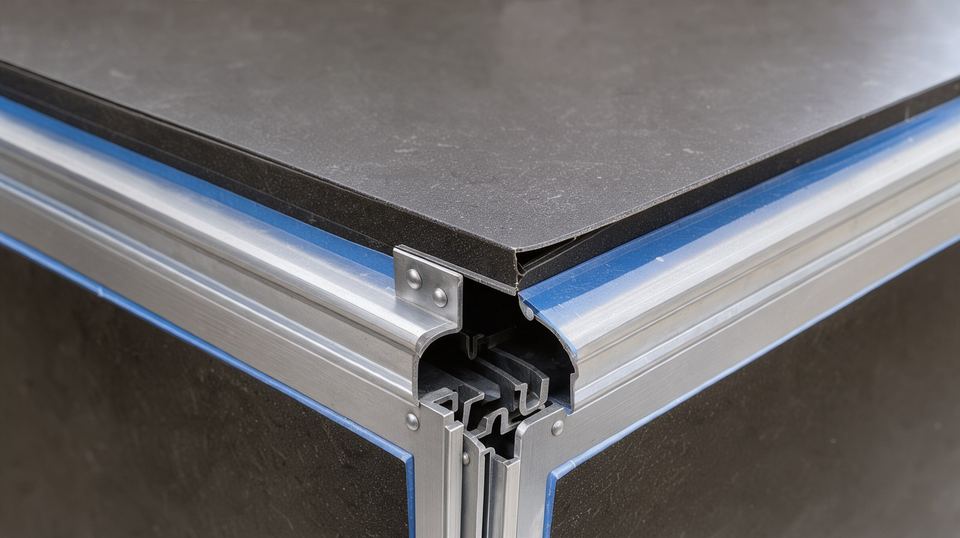
In shop panel fabrication, a CNC router cuts the flat sheet perimeter and mills V- or U-shaped grooves through the back aluminum skin and most of the core, leaving the painted face skin intact. Fabricators fold the edges 90 degrees into 1- to 2-inch returns, close corners with internal angles, rivets, or clips, attach perimeter extrusions or hanging clips, bond back stiffeners onto large modules, and label each panel to the shop drawing layout.
Wet-seal barrier joints versus dry-joint rainscreens
Over exterior sheathing, air and water barriers, continuous insulation, and sub-framing girts, panels install in two main ways:
- Wet-seal systems: route-and-return panels with roughly half-inch joints filled with backer rod and silicone sealant as a face-sealed barrier.
- Rainscreen systems: open or gasketed dry joints with no face sealant; water entering the reveal drains and dries in a ventilated cavity behind the panels, including pressure-equalized rainscreen designs.
Where ACM excels and where solid aluminum plate fits better
ACM fits flat commercial wall cladding, fascia sign bands, soffits, canopies, and column covers—commercial facades only, never roofing or residential house siding. At ground-level loading zones and high-impact entries where equipment could dent a 0.020-inch composite skin, or at heavy parapet copings and welded profiles, solid 0.080- to 0.125-inch plate panels fit better. Pricing a job? Visit bid request or call (518) 888-7938. We reply within one business day, Monday to Friday.
AI-generated illustration
ACM core, finish and specification questions
Is there any technical difference between ACM, MCM, and ACP?
All three terms describe sandwich panels made of two thin metal skins bonded to a solid core. Aluminum composite material (ACM) specifically uses aluminum skins, which represent the vast majority of commercial facades. Metal composite material (MCM) is the broader US building-code and trade umbrella that also covers zinc, copper, steel, or titanium skins, while ACP is common overseas.
Does using an FR-core ACM sheet automatically satisfy NFPA 285?
No. NFPA 285 evaluates the fire propagation performance of an entire multi-layer exterior wall assembly, not an individual cladding product in isolation. Compliance depends on combining the specific FR-core panel with tested continuous insulation types, air and water barriers, sub-framing clips, cavity depths, and window flashing details documented in the manufacturer's tested assembly chosen by the design team.
Why do metallic and mica ACM panels have directional arrows on the film?
Metallic, mica, brushed, and wood-grain coil coatings contain reflective flakes or directional grain oriented along the direction the aluminum coil traveled through the coating line. Hang two adjacent panels ninety or one hundred eighty degrees out of orientation and sunlight reflects differently off each module, making identical paint batches appear mismatched on the finished facade.
Why doesn't the exterior aluminum skin crack when an ACM return is folded?
During CNC routing, a shaped bit cuts through the rear 0.020-inch aluminum skin and mills a calculated V- or U-profile groove out of the core while leaving a thin web of core and the entire front aluminum skin untouched. That relieved geometry lets the return flange fold cleanly to ninety degrees without over-stretching the ductile coil-coated face skin.
When should protective peel-off film come off newly installed ACM panels?
Factory protective film shields PVDF finishes during CNC routing, transport, scaffold handling, and nearby masonry or sealant work, then peels off cleanly once overhead messy trades finish. Leaving film baked in direct summer UV exposure for extended months can degrade the temporary adhesive, so crews coordinate removal elevation by elevation as scaffold bays strip down.
Turn ACM specifications into a built facade
- ACM panel service
Fabrication, field installation, or both across the Capital Region.
- Wet-seal panel systems
Face-sealed route-and-return panels with backer rod and silicone joints.
- Dry-joint rainscreens
Open and spline reveals over a drained, ventilated wall cavity.
- Solid aluminum plate
Single-skin 0.080 to 0.125 in plate for impact zones and copings.
- Send drawings for a bid
Upload architectural elevations and Section 07 42 00 specs.
Working through Section 07 42 00 panel details?
Book spring work now. Winter assessments and estimates available.